Are you asking ChatGPT to help manage your leaves? Well, you’re not alone.
During a recent webinar, we heard from attendees who are relying on a mix of Excel, manual tracking and ChatGPT for leave management and payroll calculations. This is very common and reflects our own client data.
About 85% of the organizations we work with don’t use a third-party leave solution at all. Instead, they manage leave in-house, typically in a spreadsheet.
Those who do outsource are still running into delays, communication issues and inconsistencies, with none of our clients “loving” their current vendor.
Most employers don’t have a dedicated leave specialist on staff, or even a dedicated HR department. Companies under 100 employees are likely using a PEO or payroll provider (something like Gusto, Paychex, ADP, Justworks or TriNet), with a one-person “HR” team who handles PTO requests, onboarding and offboarding, training and general ops. This person is also the go-to for all leave-related questions, but is not a leave specialist.
So, here’s how the process typically unfolds:
We see that last step constantly. General-purpose AI tools regularly give confident answers that are wrong or don’t take everything into account, usually because the employee doesn’t know what’s relevant to include. Is their leave running concurrently or non-concurrently? Are they FMLA eligible? What are the extenuating circumstances?
Payroll and HRIS platforms often don’t have leave expertise built in, so they point employees right back to Google.
Leave usually happens around some of the biggest moments in a person’s life: a new baby, a surgery, a sick parent. Slow or wrong answers at that moment are how you erode trust, and eventually lose people. Without clear answers, employees feel anxious and stressed when they shouldn’t.
Time matters in leave management. For example, under FMLA, employers generally have five business days to provide an eligibility notice once they learn a leave may qualify. State programs have their own filing windows and deadlines. So when HR doesn’t know every deadline, some get missed, and that creates compliance risk and possible penalties.
This is the one we see cause the most long-term effects. When an employee receives state benefits or disability and your company pays on top, figuring out what to pay each pay period is hard. These programs run on their own pay frequency and cadence (weekly, biweekly, retroactively after leave), and employees risk being over- or underpaid. Even on unpaid leave, you have to know when payroll stops and when disability picks up. Getting pay right the first time matters to employees more than almost anything else.
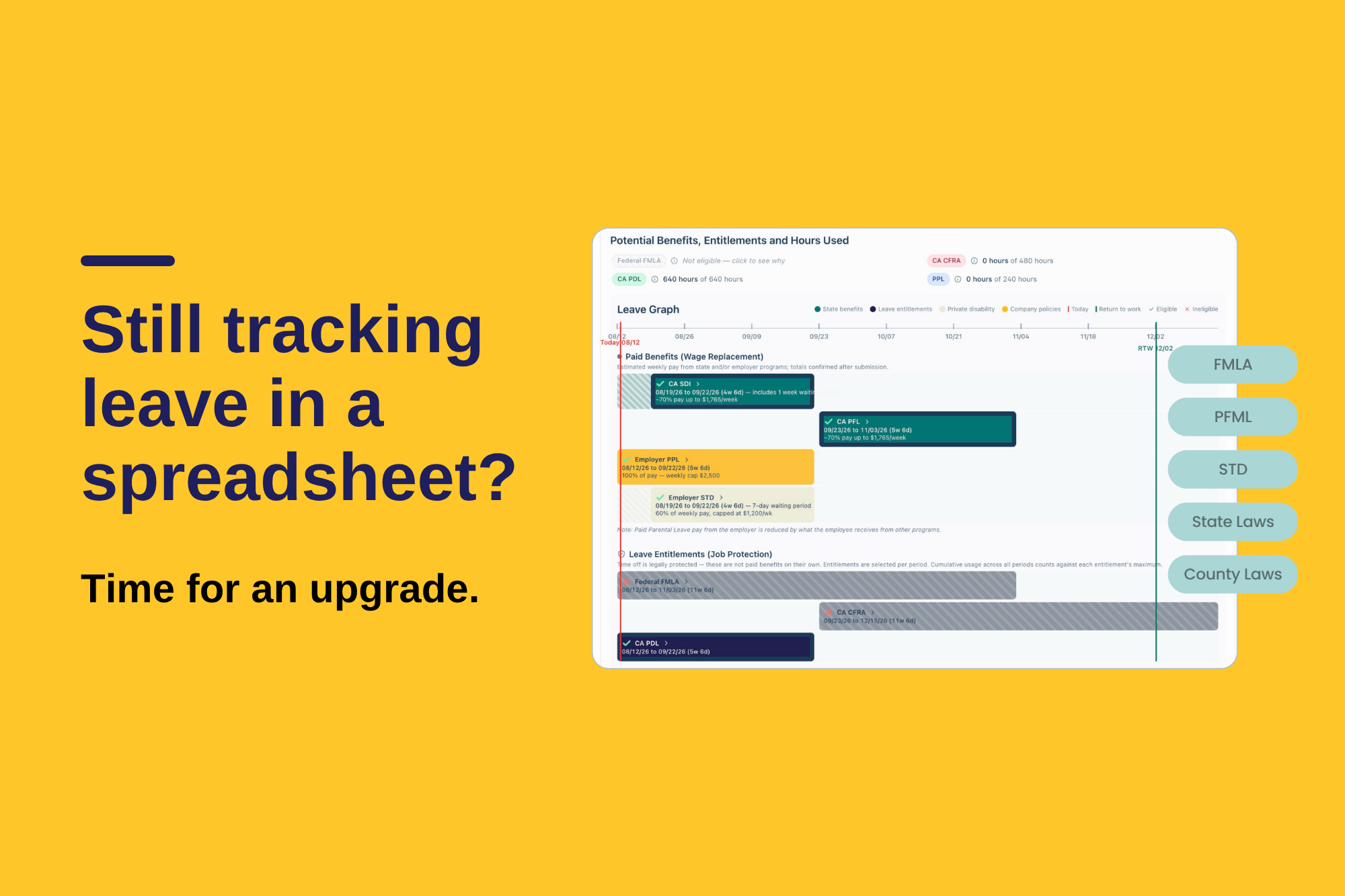
We built the Parento Leave Management System to the standard that companies need to manage leave today. It determines eligibility instantly against federal and state law, automates required documentation and gives every employee a personalized leave guide with to-dos and reminders. An AI assistant answers everyday questions, backed by real leave specialists when things get tricky.
The goal is simple: take the work off HR’s plate. Our clients save 95% of the work for half the cost of other solutions, and the system can replace your FMLA vendor entirely.
If your leave tracking lives in a spreadsheet today, it doesn’t have to. Schedule a free demo and we’ll show you what a leave looks like when the system does the heavy lifting.